
Hutchinson County Court Records After Jail Arrest
The court path in Hutchinson County begins after the arrest and booking event. The sheriff roster may show a booking number, booking date, arresting agency, charge text, and a public profile. That is useful for finding the event. It is not the same as the filed court record. The court record is where the legal case is opened, where a filed complaint, information, or indictment can appear, and where a charge status can later change.
The sheriff profile notice is direct about this split. Charges and bail amounts may change after court appearances and may not be current. It tells bond companies and people posting bail to call Hutchinson County Jail staff for the correct bail amount, charges, and case numbers. For custody and booking detail, use the Hutchinson County jail inmate records workflow. For court records after a jail arrest, pair the roster facts with the court or clerk channel.
Hutchinson County Court Records Portal
The court-records portal located for Hutchinson County is the Hutchinson County Courts Records Inquiry in Tyler Odyssey Public Access. The visible screen is login-gated. It showed User ID and Password fields, a Sign On button, and system fields tied to JusticePA. An anonymous public name-search form was not accessible from the inspected landing screen, so a person without credentials may need clerk access, in-person terminal access, or a direct court records request.
The official login page is shown below from the manifest capture of the Hutchinson County Courts Records Inquiry. It is the relevant image for court records after a jail arrest because it shows the case-access doorway, not the jail booking list.
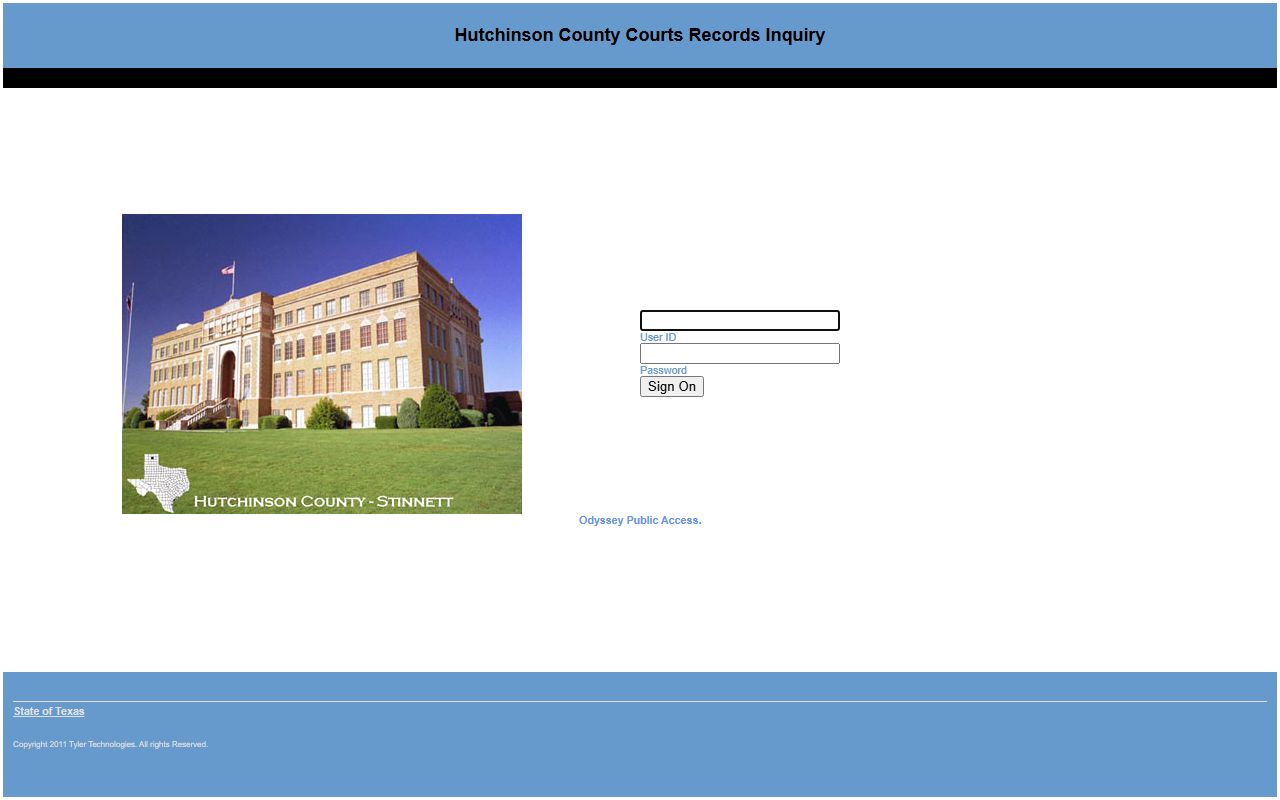
The login screen matters because Hutchinson County court records may not be fully searchable from a no-login public form. If the portal does not provide access, the practical fallback is the clerk or court office that maintains the filed case.
| Field Label | Type | Required | Options / Format Notes |
|---|---|---|---|
| User ID | Text | Yes for login | Field name UserName, maxlength 30, size 30. |
| Password | Password | Yes for login | Field name Password, maxlength 30, size 30. |
| Sign On | Submit button | Yes to enter | Button value is Sign On. |
| ValidateUser | Hidden | System | Value 1. |
| dbKeyAuth | Hidden | System | Value JusticePA. |
Find Hutchinson County Court Records
Use the jail record as the starting point, then move to the filed case. The current sheriff roster gives the arrest-side data that helps identify the defendant and event. The court or clerk record gives the filed charge and status. In Hutchinson County, that means the roster, the jail phone, and the Tyler Odyssey or clerk path should be used together.
- Start with the sheriff roster and record the booking number, booking date, arresting agency, and listed charge text.
- Call Hutchinson County Jail at 806-878-4012 when a current case number, correct charge, or bail status is needed.
- Check the Hutchinson County Courts Records Inquiry if login or access is available.
- Search by defendant name or case number when the court access point allows it.
- If the case is not online, contact the proper court clerk or use in-person records access.
A Texas Public Information Act request to the sheriff can help with booking records or reports, but it is not a substitute for the court file. Filed pleadings, settings, charge status, and dispositions are court records, while incident reports and booking materials are sheriff records. That boundary helps avoid stale or mixed-up charge information.
Hutchinson County Charging Documents
After a Hutchinson County arrest, the prosecutor decides what formal charge to file, amend, reduce, or dismiss. The research did not locate a stable current prosecutor webpage, so the safest route for filed cases is the court or clerk record. Texas criminal practice may use complaints, informations, and indictments. The exact document depends on the offense, court, and case path.
| Document | Who Uses It | Common Role | Why It Matters |
|---|---|---|---|
| Complaint | Officer or prosecutor | Often supports initial misdemeanor or warrant-related filing. | May start the formal record after the jail arrest. |
| Information | Prosecutor | Often used for filed misdemeanor charges and some non-indictment paths. | Shows the charge the state chose to pursue. |
| Indictment | Grand jury | Used for many felony prosecutions. | Can replace or differ from the booking charge text. |
The filed document can use different wording from the sheriff roster. A roster entry might begin with warrant text or a brief offense label. A court record should be checked for the filed charge, case number, court, next setting, and final outcome.
Hutchinson County Charge Status
Charge status terms show where a court record stands after a jail arrest. The status may be pending for weeks or months. It may later be amended, reduced, dismissed, or resolved by plea, trial, deferred adjudication, or other court action. A charge is only an accusation until a court reaches a final result.
| Status | Meaning in the Court Record | Roster Caution |
|---|---|---|
| Pending | The case or charge has not reached a final disposition. | The roster may still show arrest-side wording. |
| Amended | The filed charge was changed by court or prosecutor action. | The booking charge may not match the new charge. |
| Reduced | The charge level or offense was lowered. | The jail profile may still show older text. |
| Dismissed | The charge was terminated or not pursued further in that case. | A dismissal is not always visible in jail custody data. |
| Convicted | The case ended with a guilty plea, verdict, or adjudication as reflected by the court. | Do not infer conviction from arrest alone. |
Hutchinson County Bond Court Records
Bond in Hutchinson County follows Texas Code of Criminal Procedure Chapter 17 and local court or magistrate action. The jail profile warning is important here. Bail can change after court appearances, and the web profile may not show the current amount. A cash bond, surety bond, personal bond, no-bond hold, detainer, or parole blue warrant can each affect release in a different way.
The sheriff menu includes an official Warrants page, but the research did not find a usable public warrant search table or name form there. If a warrant led to the arrest, the jail roster may show warrant-related text. The sample profile research noted charge text beginning with WRNT. Bench warrants and other court warrants may also appear first in the court case file rather than in a public sheriff list.
Verification point: For a booked person, call 806-878-4012 before relying on roster bond or charge text for court, bail, or release decisions.
Hutchinson County Charges vs Convictions
A Hutchinson County court record after a jail arrest may contain both charge history and final disposition. Those are not the same. An arrest can result in no filed case, a different filed charge, dismissal, deferred action, plea, or conviction. The court record should be read by status and date, not by the first charge label seen on the jail roster.
| Point of Comparison | Charge | Conviction |
|---|---|---|
| Legal stage | An accusation filed or listed after arrest. | A final guilty result or adjudication in court. |
| Proof level | May be based on arrest facts, warrant, complaint, information, or indictment. | Requires plea, verdict, or court finding under criminal procedure. |
| Record reading | Look for pending, amended, reduced, or dismissed status. | Look for final judgment, sentence, probation, or disposition language. |
| Practical use | Shows what the state alleged. | Shows the case outcome, if one exists. |
Hutchinson County Sealed Court Records
Texas distinguishes expunction from records that are sealed or limited by nondisclosure. Chapter 55A of the Texas Code of Criminal Procedure governs expunction for eligible criminal records. Expunction is the stronger remedy. Sealing or nondisclosure limits public access but does not always erase every government use. Eligibility depends on the case result and court order.
| Point of Comparison | Sealed or Nondisclosed | Expunged |
|---|---|---|
| Public visibility | Public access is limited by order. | Eligible records may be removed or destroyed under the order. |
| Government access | Some agencies may retain limited access. | Access is much narrower and controlled by the expunction order. |
| Best fit | Cases eligible for nondisclosure or sealing relief. | Eligible arrests, dismissals, acquittals, or other qualifying outcomes. |
| Where to start | Review the court record and Texas eligibility rules. | Use the court process and provide the signed order to record holders. |
Juvenile records, active law-enforcement information, victim data, medical facts, and sealed court material may be restricted even when basic arrest information is public. Booking photos and mugshots are handled separately from the court charge file; the Hutchinson County jail mugshots page covers the booking-photo side.
Hutchinson County Court Record Access
Texas Government Code Chapter 552, the Texas Public Information Act, gives a process for requesting government records unless an exception applies. Section 552.108 is often relevant to active law-enforcement records. Court filings are reached through the court or clerk path, while sheriff booking records and incident records are reached through the sheriff Records/CJIS contact.
Texas Code of Criminal Procedure Chapter 15 covers arrest warrants and arrest procedure, Chapter 16 covers the magistrate and commitment framework after arrest, and Chapter 17 covers bail and personal bonds. Those statutes explain why a Hutchinson County jail arrest can quickly create more than one record stream: jail custody, bond status, warrant status, and the filed court case.
Important: Public-record lookups are not consumer reports and should not be used for employment, housing, credit, insurance, or another FCRA-regulated decision.